
Clarke County Court Records After Arrest
The arrest-to-court path in Clarke County moves through several offices. A person is arrested by Athens-Clarke County Police, the sheriff, UGA police, or another agency, then booked at the Athens-Clarke County Jail. The jail record may show the booking time, initial charge, arresting agency, bond, and police case number. A court record begins when a charging document, first appearance, warrant matter, accusation, indictment, or other case filing is opened in the proper court.
Booking charges are not the same as formal court charges. The Western Judicial Circuit District Attorney's Office serves Clarke and Oconee counties and decides what charges to pursue in many Superior and State Court criminal matters. Prosecutors may file different charges than the jail profile first showed, amend a count, reduce a count, dismiss it, or present a felony case to a grand jury. A jail charge is an accusation at intake, not a conviction.
For custody and booking facts, use the Clarke County jail inmate records page. For booking-photo limits, use the Clarke County jail mugshots page. Court records after an arrest focus on filed charges, case numbers, bond hearings, court jurisdiction, disposition, and record visibility after the case ends.
Search Court Records After Arrest
The Clerk of Superior and State Courts is the main local record office for Superior Court and State Court case files. The official clerk page links the civil/criminal court docket. The captured landing page used an iframe or redirect path, so exact form labels were not captured in text. Use careful language when describing it: search by party name or case number when those fields are available, and contact the clerk criminal division if the online docket does not expose the case.
- Collect the jail profile details: full name, booking date, charge description, case number, police case number, and arresting agency.
- Search the clerk civil/criminal docket for the defendant or case number if a court case number appears on the jail record.
- If no Superior or State Court case appears, check whether the case is still in Magistrate Court, Municipal Court, or prosecutor intake.
- Read each charge separately because status, bond, plea, sentence, dismissal, or disposition can differ by count.
- For older or unavailable records, call or visit the Clerk of Superior and State Courts during posted business hours.
The official clerk screenshot from the Clerk of Superior and State Courts page shows the local record office, hours, court docket link, fee note, and scam warning.
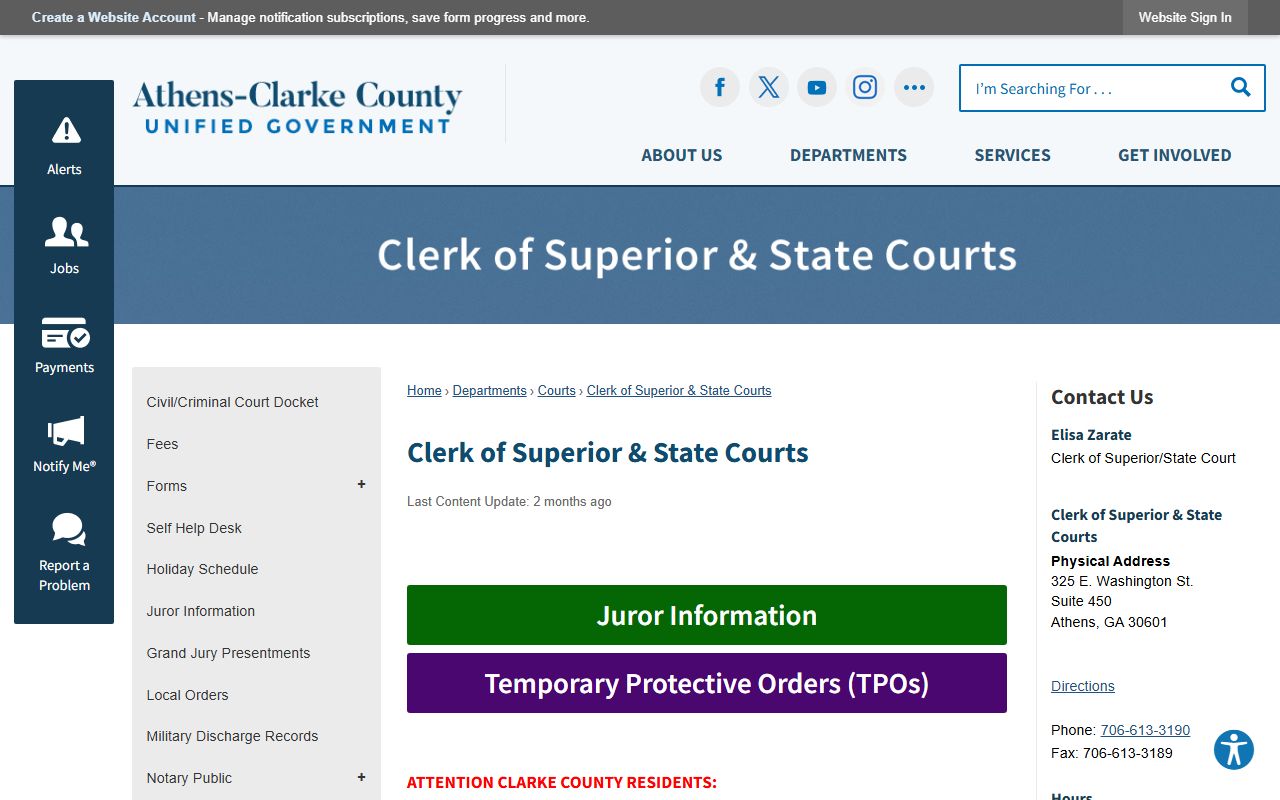
The clerk is the record holder for court-file access. The District Attorney prosecutes cases but is not the court clerk for docket copies.
Clarke County Court Contacts
Different courts handle different parts of the case after a jail arrest. Magistrate Court is the court of entry into the criminal justice system and handles first appearances, bond hearings, preliminary hearings, and pre-warrant hearings. State Court handles misdemeanor criminal cases, including traffic and DUI matters within its jurisdiction. Superior Court handles felony cases and grand-jury matters. Municipal Court handles Athens-Clarke ordinance cases, state misdemeanor traffic including DUI, and specified misdemeanors such as shoplifting, underage alcohol possession, and possession of less than one ounce of marijuana.
| Office | Contact | Role After Arrest |
|---|---|---|
| Clerk of Superior/State Courts | 325 E. Washington St., Suite 450, Athens, GA 30601; 706-613-3190; Monday-Friday 8:30 AM-5:00 PM | Court docket and case-file access for Superior and State Court matters. |
| Superior Court | 325 E. Washington St., Suite 400; 706-613-3161; Monday-Friday 8:00 AM-5:00 PM | Felony cases, serious criminal matters, and grand-jury flow. |
| State Court | 325 E. Washington St., Suite 425; 706-613-3200 | Misdemeanor criminal cases, DUI, family violence, traffic, and theft matters listed by the court. |
| Magistrate Court | Magistrate Court and case-status link through athensclarkemagistratecourt.com | First appearances, bond hearings, preliminary hearings, and pre-warrant hearings. |
| Municipal Court | 325 E. Washington St., Suite 170; 706-613-3690; municipalcourt@accgov.com | Ordinances, traffic, DUI, and specified misdemeanor jurisdiction. |
| District Attorney | 325 E. Washington St., Suite 370; 706-613-3240; Monday-Friday 8:00 AM-5:00 PM | Prosecution decisions, accusations, indictments, amended charges, pleas, and victim services. |
First Appearance After Arrest
First appearance is the early court event that follows many jail bookings. The official Magistrate Court first-appearance page says hearings are held every day. Weekday hearings are usually at 8:30 AM at the courthouse. Weekend and holiday hearings occur at the Clarke County Jail at a time set by the judge, and the listed phone for weekend or holiday timing is the jail number, 706-613-3270.
At this stage, a court may address probable cause, bond, release conditions, future hearings, or whether the case should move toward another court. A person can be in the jail roster before the formal Superior or State Court docket is easy to find. That does not mean the arrest vanished. It may mean the case is in the first-appearance or prosecutor-review stage.
Timing point: The jail roster has a 24-hour booking delay, while court filings may take their own path through Magistrate Court, prosecutor review, and the clerk docket.
Clarke County Charging Documents
Formal court records after an arrest depend on the charging document and court. Georgia practice can involve a complaint, accusation, information-style filing, or indictment, depending on the offense level and route. The research did not capture every Clarke County docket label, so the safest treatment is functional: identify who filed the charge, what court controls it, and whether the case is still pending or resolved.
| Document | Who Uses It | What It Means |
|---|---|---|
| Complaint or warrant matter | Officer, prosecutor, or Magistrate Court path | Often tied to the early arrest, first appearance, probable-cause, or pre-warrant stage. |
| Accusation or information-style filing | Prosecutor | A prosecutor-filed charging document used for many non-grand-jury criminal cases. |
| Indictment | Grand jury | A grand-jury charging document, common for serious felony matters in Superior Court. |
Clarke County Charge Status
A charge can change after booking. The jail profile may list one charge on the roster table and a fuller charge table on the profile, but the prosecutor and court docket control what happens next. The court record may show pending, bound over, amended, reduced, dismissed, nolle prosequi, plea, sentence, or conviction status. Read status by count, because one charge may be dismissed while another remains pending.
| Status | Plain Meaning |
|---|---|
| Pending | The case or count has not reached final disposition. |
| Bound over | A lower-court matter has moved toward a higher court or prosecutor filing path. |
| Amended or reduced | The filed charge changed, often to a different grade or offense description. |
| Dismissed | The court or prosecutor ended that count without a conviction on that count. |
| Nolle prosequi | The prosecutor abandoned or declined to continue that charge. |
| Plea, sentence, or conviction | The charge reached a court outcome after a plea or finding. |
Bond After Clarke County Arrest
Bond is tied to both the jail profile and the court process. The roster can show a bond amount on the list and per-charge bond amounts or remarks on the profile. Bond remarks may signal no-bond conditions. Even when a Clarke County charge has a bond amount, release can be blocked by another hold, such as probation, parole, another county, another state, federal custody, or immigration detention.
| Bond Type | How It Works |
|---|---|
| Cash bond | Money paid directly under current jail or court rules. |
| Surety bond | A licensed bonding company posts bond under its fee and court rules. |
| Property bond | May be allowed by court or sheriff procedure, but no Clarke-specific instructions were found. |
| Personal recognizance | Release on promise or conditions without paying the full cash amount. |
| No-bond hold | Release is not available until a judge or case status changes the hold. |
Before sending money or calling a bonding company, confirm the person is still at the Athens-Clarke County Jail and ask whether any hold blocks release. Inmate account money may be used for bail or fines, but the jail account cap is $200 and mailed money orders have their own rules.
Warrants Leading to Arrest
The sheriff's office states that it serves criminal warrants, and the official quick links include a Clarke County Sheriff's Office Wanted Fugitives page. That page is not a complete all-warrant database. It is a selected public wanted-persons source and tells the public not to try to apprehend anyone. Tips were routed in the research to 706-338-3432 or Athens-Clarke County Crime Stoppers at 706-705-4775.
A warrant may lead to a jail booking, but warrant records and court records can sit in different places. An arrest warrant authorizes arrest for a criminal charge. A bench warrant is issued by a judge, often for failure to appear or a court-order violation. A search warrant authorizes a search, not an inmate lookup. When a warrant is executed and the person is booked, the current prisoner listing should eventually show the booking after the 24-hour delay.
Charges vs Convictions
A Clarke County arrest, booking, or filed charge is not the same as a conviction. The jail record shows custody and intake facts. The court record tracks the formal case. A conviction requires a plea or finding. Public readers should avoid treating a roster charge or pending docket entry as a final outcome.
| Point | Charge | Conviction |
|---|---|---|
| Stage | Accusation or filed count after arrest. | Final outcome after plea, verdict, or finding. |
| Record Source | Jail profile, prosecutor filing, or court docket. | Court disposition, sentence, or judgment entry. |
| Meaning | Alleged conduct still subject to change. | Legal finding or accepted plea. |
| Public caution | Can be amended, reduced, dismissed, or abandoned. | Can still be appealed, corrected, or restricted where law permits. |
Restricted Court Records After Arrest
Georgia often uses the term record restriction for what many people call expungement. Under Georgia record-restriction procedures tied to O.C.G.A. 35-3-37, eligible records may be restricted from public criminal-history access after certain dismissed, non-prosecuted, or otherwise qualifying outcomes. Georgia.gov and GBI/GCIC materials distinguish criminal-history records from local court files, so a person may need to address both criminal-history restriction and court-record visibility.
| Issue | Sealed / Restricted | Expunged |
|---|---|---|
| Georgia wording | Record restriction is the common Georgia access-limit term. | Expungement is often used by the public, but Georgia materials route many requests through restriction. |
| Public access | Eligible criminal-history information may be limited from public view. | Not always literal destruction of every related court or agency record. |
| Who to contact | GBI/GCIC, the arresting agency, prosecutor, or court depending on the record. | Confirm the Georgia process before assuming an out-of-state model applies. |
Important: This site is not a consumer reporting agency and is not for employment, tenant, credit, insurance, or other FCRA-covered screening.